
Introducing Assist
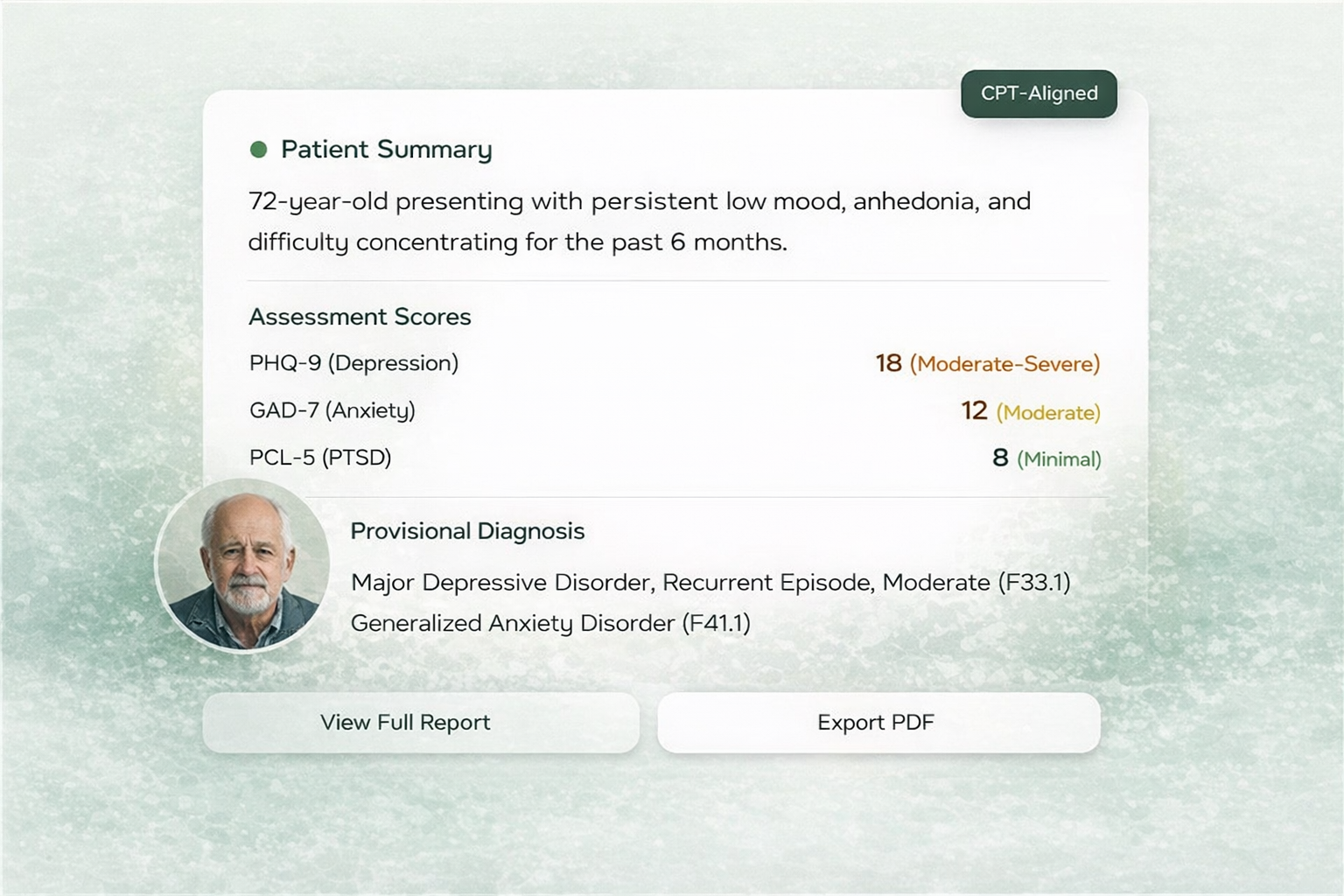


Zenara Assist runs alongside your EHR to help your practice deliver deeper first visits, routine measurement-based care, and organized coordination between sessions. Built from workflows I use in my own psychiatry practice—refined for groups like yours.
Validated in clinical practice: comprehensive assessments identify an average of 8–10 conditions per patient vs. 2.8 in published benchmarks. See Proof →

Sidecar to your EHR—not a rip-and-replace
- Works alongside your current EHR and practice systems
- Posts summaries and notes back with provenance where integration allows
- Can start in standalone mode and integrate more deeply over time
We know changing EHRs is a non-starter for most practices. Zenara Assist is designed as a sidecar: it handles assessment, outcomes, and care-management workflows, then posts key artifacts back into your existing systems. You keep your EHR, scheduling, and billing tools; we help them work together with less friction.
We currently integrate with select EHRs and are expanding support. Many practices begin with standalone Assess and move into deeper integration as they see value.
Three modules. One continuous system.
Zenara Assist is one platform with three modules. Most practices start with Assess, then add Monitor and Care as they’re ready. Together, they support a full care model—from intake and diagnosis to outcomes and continuous care management.
Assess – available Q1 2026
Assess deeply
The most comprehensive mental health assessment.
It turns patient self‑report and a brief human review into a whole‑person picture and documentation you can actually bill and treat from. You have complete understanding before the first word.
How are you feeling?
How are your sleep patterns?
Monitor — Coming 2026
Monitor continuously
Mental vitals by default—treat-to-target becomes routine.
Outcomes stop being invisible. PHQ-9, GAD-7, labs, and vitals are automated, trended, and actionable.
• PHQ-9
• GAD-7
Care – Coming 2026
Care cohesively
We take care of patients; we optimize, bill, and manage the program.
Under-the-waterline orchestration. Helps your team keep patients connected between visits and supports clean monthly claims.
• Goals met
• Barriers cleared
• Interventions complete

From first visit to continuous care
Assess fixes the front door: you start with better information and cleaner documentation. Monitor makes measurement routine, so you see whether care is working across patients and clinicians. Care organizes what happens between visits and supports the care-management models that make that work sustainable.
Whole-person intake and testing with CPT-aligned documentation
Routine outcomes and trends visible at a glance
Between-visit coordination and care documentation, billed and paid for

Designed first for psychiatry practices
If you own a psychiatry practice, you're trying to deliver deep, continuous care inside systems optimized for volume. You've built what you can—but it's messy: onboarding artifacts scattered, case reviews inconsistent, care plans you try to follow, billing siloed, life events tracked in sticky notes, and a caseload growing your lists but not your capacity.
- First visits that start with a coherent picture instead of 50 minutes of data gathering
- Measurement-based psychiatry as a default, not a side project
- Care-management models you can grow into when your team and payers are ready
Aligned with modern care models
Zenara Assist is not just about documentation—it’s about making it practical to run the care models that payers, regulators, and communities are pushing toward.
- Psychiatric evaluations (90791 / 90792 / 99205)
- Psychological testing (96138–39 / 96130–31 / 96127)
- Health behavior & cognitive assessments (96156 / 99483)
- Behavioral health integration (99484)
- Collaborative care management (99492–94)
- Chronic care management (99490 / 99487 / +99489)
- Advanced primary care management (99426 / 99427)
- GPCM-ready documentation (when finalized)
* Coverage and reimbursement vary by payer and state. In a practice assessment, we focus on what’s realistic for your contracts and regulations.
Learn how these care models really work
If you’re still mapping your options, we have put together our brilliant resources to help you get started.
CCM vs CoCM vs BHI: a practical guide for psychiatry and therapy practices
APCM now, GPCM coming: a primary care leader’s guide
Adding psychiatric coverage to a therapy practice: a grounded playbook
Five Cases Standard Care Would Have Missed
Built inside clinical reality
Zenara Assist comes from building integrated behavioral care where scale, rigor, and real‑world constraints are non‑negotiable—and pressure‑testing what actually holds up in day‑to‑day clinical work.
- At Kaiser Oakland, I helped build primary care behavioral health integration across a 500,000‑patient catchment—including high‑leverage psychiatric consultation workflows and early telepsychiatry pilots.
- At Headspace Health (fka Ginger.io), as the first clinical hire and Head of Clinical Programs, I was there for the defining pivot from data science to clinical service delivery—and helped build a stepped‑care model using health coaching and mindfulness.
- In Intuitive Psychiatry, I’ve spent a decade practicing measurement‑based care—the same environment where Zenara is built and tested under real clinical conditions.
How we start working together
Step 1 — Practice assessment
We talk through your practice: clinicians, visit types, panel composition, payer mix, current service lines, and pain points.
Step 2 — Start with Assess
We configure Assess to align with your workflows and run your first cohort of patients. You’ll feel the difference in your first visits—and see reimbursement cycling.
Add Monitor and Care when you’re ready
When it makes sense, we introduce routine measurement (Monitor) and organized between-visit coordination (Care), so continuous care and care-management models become part of your new normal—not a side project.
Common questions about Zenara Assist
Do we have to roll out all three modules at once?
No. Most practices start with Assess, get comfortable, and then adopt Monitor and Care as they’re ready. The platform is modular by design.
Do we have to change our EHR or billing system?
No. Zenara Assist is a sidecar. We complement your existing EHR and billing tools; we don’t replace them.
Is this an 'AI therapist' or does it make decisions?
No. Zenara Assist organizes information, supports documentation, and helps manage workflows. Clinicians remain fully responsible for all diagnoses and treatment decisions.
Is this just for large health systems?
No. Zenara Assist was built first for mid-size psychiatry and behavioral practices. We do work with health systems, but our design center is the independent clinic that needs to work in the real world now.
How is Zenara different from other mental health software?
Most mental health software focuses on documentation OR measurement OR care coordination — rarely all three, and usually as features bolted onto a general-purpose system. Zenara Assist integrates all three into one coherent platform, built by a practicing psychiatrist from workflows that actually work in real clinics. We’re a clinical sidecar designed specifically for behavioral health, not an EHR add-on.
What's the implementation timeline?
Most practices are up and running with Assess within 2-4 weeks. We handle configuration, training, and workflow mapping. The goal is to feel the difference in your first visits quickly, not to spend months on implementation. Monitor and Care add incremental implementation time when you’re ready for them.
Do you offer training and support?
Yes. Every practice gets onboarding, role-specific training for clinicians and staff, and ongoing support. We want Zenara to work for your team — not just exist in your tech stack. Your success is how we measure ours.
What if Zenara isn't the right fit for our practice?
We’ll tell you. In your practice checkup, we look honestly at whether our approach fits your situation. If care-management models don’t make sense for your payers, or if you need capabilities we don’t offer, we’ll say so upfront. We’d rather have an honest conversation than a frustrated customer.
If you want your workflows to match the medicine you believe in, let's talk
Zenara Assist is how I reconciled deep, integrative psychiatry with the realities of modern reimbursement and burnout. If you're ready to explore whether this suite makes sense for your practice or system, the next step is a conversation.
Ready to talk? Get a practice checkup. Want to stay informed as Assess launches? Join the waitlist.
