
Introducing Zenara Assist
Your clinical sidecar for modern psychiatry
Zenara Assist runs alongside your EHR to help your practice deliver deeper first visits, routine measurement-based care, and organized coordination between sessions. Built from the workflows I use in my own clinic, it's designed for teams who want meaningful medicine and a business that lasts.
Shorter visits. Portal overload. Invisible work between sessions…
If this is your reality, I've lived it too — and spent 10 years building a way out.
Whether you lead a psychiatry group, therapy practice, or primary care clinic with real behavioral health needs — the system is squeezing you. I'm a psychiatrist who spent 10 years building workflows that actually work: deeper first visits, visible outcomes, sustainable coordination. Zenara Assist is how I'm making those workflows available to practices like yours.
Ravi Hariprasad, MD, MPH
Founder & CEO, Zenara Health
Practicing Psychiatrist, San Francisco
Who This is For
Built for leaders of behavioral health and primary care practices who want to deliver excellent care sustainably
Zenara Assist — your clinical sidecar
Zenara Assist snaps into your existing EHR and workflows. It doesn’t replace what you’ve built—it activates it. We start with better assessments, then make measurement routine, then turn continuous coordination into clean monthly revenue.
Assess – available Q1 2026
Assess deeply
The most comprehensive mental health assessment.
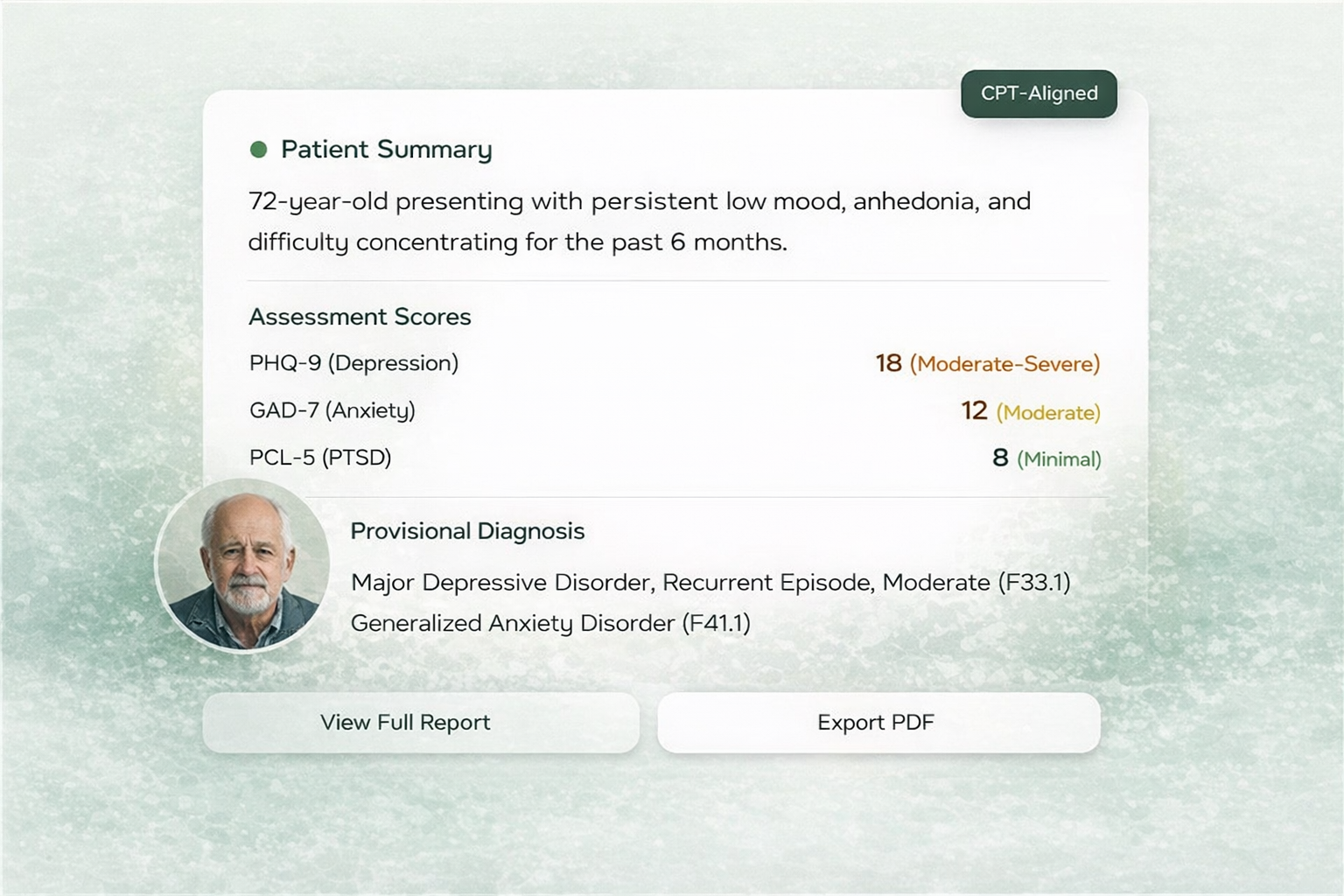
It turns patient self‑report and a brief human review into a whole‑person picture and documentation you can actually bill and treat from. You have complete understanding before the first word.
How are you feeling?
How are your sleep patterns?
Monitor — Coming 2026
Monitor continuously
Mental vitals by default—treat-to-target becomes routine.
Outcomes stop being invisible. PHQ-9, GAD-7, labs, and vitals are automated, trended, and actionable.
• PHQ-9
• GAD-7
Care – Coming 2026
Care cohesively
We take care of patients; we optimize, bill, and manage the program.
Under-the-waterline orchestration. Helps your team keep patients connected between visits and supports clean monthly claims.
• Goals met
• Barriers cleared
• Interventions complete
Start with Assess — complete understanding before the first word
Assess is the first step. It gives you a coherent, whole-person picture of each patient before you walk into the room and generates CPT-aligned artifacts for psychiatric evaluations and psychological testing. The first minute can be clinical, not just administrative.
- Psychiatric/Psychological Intake or Psychological Testing—your preference
- Supports documentation for evaluations, testing, health-behavior and cognitive assessments
- Team members can help with intake prep; clinicians focus on interpretation and treatment decisions
Already working in the real world
8-10
diagnoses identified per patient in clinical validation
vs. 2.8
(the benchmark in standard psychiatric evaluations)
50-75%
higher remission rates with measurement-based care*
2x
treatment response with collaborative care models*
*APA guidelines, Fortney et al., 2017; IMPACT trial, Unützer et al., 2002
Built on proven approaches
Practices using routine symptom measurement see 50-75% higher remission rates compared to usual care (APA guidelines, Fortney et al., 2017). Collaborative care models more than double treatment response and remission (IMPACT trial, Unützer et al., 2002).
In our partnership with Texas Center for Lifestyle Medicine, comprehensive assessment identified bipolar disorder missed for years, surfaced undisclosed trauma, and caught supplements causing the symptoms they were meant to treat.
What changes when you use Zenara
Without Zenara
First visit eaten by fact-finding
Outcomes invisible between visits
Important details discovered late, if at all
Coordination scattered across inboxes
With Zenara
First visit focused on formulation and treatment
PHQ-9, GAD-7, and other measures tracked automatically
Risks, patterns, root causes, and social determinants—all surfaced before you walk in, so you can practice true biopsychosocial medicine
Between-visit work organized and billable
Aligned with modern care models
Zenara Assist is designed to support the care models and service lines practices are actually being asked to run—not just visits but continuous, integrated care.
- Psychiatric evaluations (90791 / 90792 / 99205)
- Psychological testing (96138–39 / 96130–31 / 96127)
- Health behavior & cognitive assessments (96156 / 99483)
- Behavioral health integration (99484)
- Collaborative care management (99492–94)
- Chronic care management (99490 / 99487 / +99489)
- Advanced primary care management (99426 / 99427)
- GPCM-ready documentation (when finalized)
* Coverage and reimbursement vary by payer and state. In a practice assessment, we focus on what’s realistic for your contracts and regulations.
Learn how these care models really work
If you’re still mapping your options, we have put together our brilliant resources to help you get started.
CCM vs CoCM vs BHI: a practical guide for psychiatry and therapy practices
APCM now, GPCM coming: a primary care leader’s guide
Adding psychiatric coverage to a therapy practice: a grounded playbook
Five Cases Standard Care Would Have Missed
What comprehensive assessment actually finds
Real findings from clinical validation.
Case Study 01
David’s Story:
He was convinced he had early dementia. Memory slipping. Projects unfinished. Standard screening showed minimal symptoms—easy to dismiss.
Assess found something different: his “cognitive decline” was actually anxiety driven by profound social isolation. He lived alone. No one nearby. The real diagnosis wasn’t dementia—it was loneliness.
— David, 72 | PHQ-9: 1 | PROMIS Cognitive: Normal
Case Study 02
Miguel’s Story:
PHQ-9: 4. GAD-7: 2. Everyone said he was fine.
But he experienced debilitating symptoms that came and went—invisible to screening that averages across time. Assess found the supplement he was taking for brain fog had brain fog as a documented side effect. The treatment was causing the problem.
— Miguel, 18 | PHQ-9: 4 | The cure was the cause
Case Study 03
Nadia’s Story:
Referred for social anxiety. Assess found she was drinking six espresso shots daily—self-medicating probable ADHD while the caffeine amplified her anxiety.
She didn’t need an SSRI. She needed to address the caffeine first, then evaluate what was underneath.
— Nadia, 39 | GAD-7: 7 | Root cause: caffeine, not anxiety disorder
If this sounds like the way you want to practice, let's talk
Excellent care, your own wellbeing, and a sustainable business. You don't have to choose anymore. Zenara Assist is how I reconciled those in my practice. If you're ready to see what that might look like in yours, the next step is a practice checkup.
Ready to talk? Get a practice checkup. Want to stay informed as Assess launches? Join the waitlist.
